Blood on the Stage: On Pain
- cryptidkidsideshow
- May 9, 2025
- 9 min read
"There is no greater agony than bearing an untold story inside you." - Maya Angelou
As I walk up the stairs onto the stage, into the glow of a row of lights overhead, I am already trembling. Not because of the chill in the fall air or from exhaustion after a day of roaming and stage shows. Because the two hooks piercing my back feel ice cold as they lie flat between my shoulder blades, where the skin feels like its burning. I come to a stop beneath a 10 foot tall aerial rig, where my piercer gently turns me to face the audience, which is only a haze of faces until my eyes adjust to the glare. As I focus on steadying my breath, I feel him move behind me, threading lengths of black paracord through the hooks and attaching them to the rigging apparatus above my head. Then he steps to my side and takes my hand. Shaking from the pain and excitement, I smile and tell him I'm ready. And at his cue to the sound technician, it begins.
As wailing guitars and booming bass start to echo across the stage, I take my first step forward. I see the audience clearly now, a sea of faces watching me, and my heart starts to race. My piercer pulls on the ropes, and I feel a jolt of pain across my back as the hooks slowly separate my skin from the underlying muscle. I step back and forth, further each time as he pulls harder and harder. The pain crescendos with the music, and I feel my whole body vibrating from adrenaline as he pulls me higher and higher until I'm on the tips of my toes. Finally, when the music builds to the first chorus and the pain becomes almost unbearable, I lift my feet off the ground. And then I'm flying, swinging back and forth held aloft only by the hooks embedded in my skin.
I hear screams of shock and delight from the audience, and as I turn my head I can see my fellow performers cheer me on from backstage. I twist my body, arching back to grab my feet, curling into a ball, whipping my legs around until I spin in a tight circle. My piercer grabs my legs and lifts me high, then swings me forward until I soar above his head. I'm high off a flood of endorphins, the pain in my back now only a dull ache.
I slow with the music, as my piercer lowers the ropes. My toes touch the ground, but my legs are jelly and I can't stand. He gathers me tightly in one arm and I sink into his chest, my head spinning. I nod that I'm ready, and he cuts the ropes with one quick slice. I feel one last flare of pain across my back as I collapse into his arms, just in time to hear the music fading and the applause swelling.
Why do I do it if it hurts?
I started inflicting pain on myself when I was 16. I used the blade of an Exacto knife to make cuts on my wrist, just deep enough to leave three or four thin trails of blood that I'd cover with bandannas. Self-harm is common for teenagers like I was, depressed and anxious from bad childhoods and struggling with nascent feelings of queerness. Many LGBTQ+ teens self-injure to cope with the alienation, tension, invisibility, and invalidation that comes along with being young and queer. I turned this pressure on myself as a way to control it, to transmute unnamable mental anguish into tangible physical pain that began, ended, and healed. I used pain to break through the dissociative numbness I felt, to express feelings I couldn't say out loud. My pain reflected suffering, an anger at the world turned inwards and directed on my body, driven by impulses I didn't fully understand.
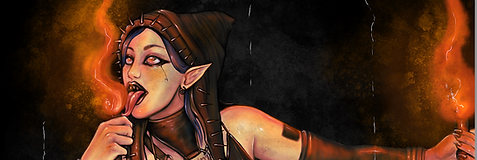
On the surface, it might appear that the painful feats I put my body through now - the sword swallowing, the needle and fire play, the hook suspension - are no different than my past use for a knife. One might assume that they are escalations of the same drive to harm myself, arising from the same feelings of alienation and despair. And I'll admit, I likely would not have fallen in love with sideshow if I wasn't drawn to pain's power to ground and calm me. But I am certain that becoming a sideshow performer has transformed my relationship to pain into something completely different than self-harm.
In The Culture of Pain, an exploration of pain across histories and cultures, David B. Morris states that "the human experience of pain also inescapably involves our encounter with meaning." He writes that pain never has a definitive meaning, but rather is always open to shifting personal and social interpretation. In essence, performing sideshow has transformed the meaning pain holds for me. Inflicting pain on myself when I'm on stage doesn't come from a desperate impulse to internalize rage or sooth myself. It has become a form of self-expression: a way to be seen.
This transformation has occurred because of one crucial difference between my teenage activities with a knife and my present adventures with nails, needles, swords, and fire on stage. The former was always performed alone and in secret. It was driven by feelings of loneliness, and the scars I gave myself felt like they marked me as different than others. The comfort self-harm brought me was rooted in isolation, in that the feeling of pain detached me from feelings of rage and frustration with the world.
Being on stage is different, because there is always an audience. And being seen in pain by an audience is everything. In "Bearing Witness: On Pain in Performance Art," Jareh Das examines "witnessing" as a lens through which pain enacted on the body becomes a powerful way for a performer to nonverbally communicate stories. He writes of performance art involving pain:
"Pain serves as a critical tool here, whether functioning metaphorically or conceptually, with the body of the artist functioning as a medium for telling their most private experiences."
For me, being witnessed transforms the personal meaning of self-inflicted pain. Instead of being driven by impulses to isolate and harm myself, I am motivated by the desire to tell stories about myself that others can understand - stories that challenge normative expectations about mental health and gender. As Das says:
"In this context, witness describes an engagement with artworks that are created with the intention to share intimate experiences such that they might allow for possibilities of social transformation."
For most of my life, I tried hard to hide how much I struggled with anxiety and depression. I was afraid of people dismissing or pitying me, or of people I loved being so burdened or exhausted by my emotions that they ended up resenting me. Managing feelings of unrelenting despair felt like a thankless, humiliating task that isolated me from other people.
But enduring pain that I control in front of an audience is a completely different experience. When I press needles through my cheeks, I see delight and awe on the audience's faces instead of pity. I am captivating. Either you are entranced by the sight of me in pain, or you are compelled to turn away, but you cannot dismiss me once I'm on stage. Enduring pain that I hated myself for being unable to end was no longer humiliating. On the contrary my capacity to endure is my strength. There are moments on stage, when I pull on the rope attaching hooks on either sides of my calves to rigging in the ceiling until my back lifts off the ground or when I drive a 12 inch needle through the flesh under my tongue... when I feel like I can't take the pain anymore... I think back on all sadness and fear I've held inside me all my life and I know with absolute certainty that the pain is, in comparison, nothing. And I wouldn't push myself to reach that place of absolute certainty if there wasn't an audience, reacting with awe and curiosity. My ability to endure self-inflicted pain transforms from an isolating ritual of coping with alienation into a metaphor for overcoming despair with the admiration and support of others. As I result, I no longer feel the need to self-harm like I did when I was young. In this vein, Das writes about performance art:
"It allows for what is experienced as not the pain inflicted by the power of control administered by the artist through the masochistic recalling of the self. This brings the self back to the body in a cathartic manner that prevents greater acts of self-harm."
I relate to what the performance artist Martin O'Brien, a disability activist from the U.K. who inflicts pain upon himself through performance art to explore his experience of managing cystic fibrosis (often integrating sadomasochistic practices and imagery akin to the work of the late Bob Flanagan, who became famous for using SM in performance art about living with cystic fibrosis), said: "Performance is the space where I can be sick in the way I want." I am not living with a life-threatening illness, but I relate to how he described the function and meaning of self-inflicted pain in his performances as centering around endurance:
"Pain functions as a metaphor of as well as actual physical pain. Both metaphor and actuality are of importance when acting together. I usually talk about my works in terms of endurance and even that in itself can be deemed as metaphor. Activities that are functioning on two levels, i.e. literal and metaphoric, although communicated through endurance, it is still used as a metaphoric act for other forms of endurance and pain."
The next story I tell through my performance art is about femininity. Like many AFAB or transfeminine people, I am intimately aware of how the patriarchy's power to control and objectify my body, both its image and its literal flesh. I feel the pressure of appearing feminine in a way that is appealing to men and to defer to how men want me to treat my body. Performing pain-proof acts enables me to reclaim that power for myself and assert control over my own body. In In The Flesh, Victoria Pitts writes that body modification:
"Subverts the social control and victimization of the female body... marking and transforming the body can symbolically 'reclaim' the body from its victimization and objectification in patriarchal culture."
For the AFAB or transfeminine performer, self-inflicted pain can be a powerful way to subvert patriarchal dominion over the body. According to Das, the stories a performer tells through self-inflicted pain in front of an audience are always political, in that they unsettle normative social expectations about a person's control over and use for their body. He writes:
"The political function of wounding within the context of live and documented performance remains central to considering pain's metaphoric or conceptual function. These actions contribute to a form of bodily trace-making that elicits a variety of responses from the viewers of such performances, which in turn serves as a form of the unmaking and destabilizing of normal and accepted representations of the body."
I use sideshow to accomplish this destabilizing and reclamation by violating beauty norms and demonstrating control over my body. I find my pierced body streaked with blood to be beautiful, and I delight in knowing that it's a turn-off for most men. I am not wasting any energy being palatable or attractive to men, I am instead demonstrating my power to unsettle and disturb conventional expectations of how I should use my body should make others feel. When I ease a 17-inch steel blade down my throat or manipulate fire in my mouth, I am exercising a level of precise control over my body that no one else could ever accomplish. In Pitts' words: "ritualized marking symbolically revokes former claims on the body - those of victimization, patriarchy, and control." Sideshow allows me to embrace a femininity that isn't chained to the male gaze, to heteronormative expectations about my body's purpose, or to patriarchal control over my image and flesh.
Again, having an audience is crucial. This reclamation is possible because, as Pitts observed, the meaning of bodies is always in flux: "opened to the public possibilities of reinscription and renaming." She writes that the processes of reclaiming through body modification "co-construct a set of meanings that must share authorship with other intersubjective forces of inscription and interpretation."
The last story I tell is about masculinity. Returning to O'Brien, his performance art unsettles normative ideas not just of disability, but also of masculinity. He destabilizes the cisnormative idea that when men allow themselves to be seen in pain, it must be to prove their stoicism, virility, and invulnerability. Through his performance, he reframes strength and empowerment to be a quality of the vulnerable, sick body - a body that a cisnormative society would regard as emasculated. Personally, I find masculinity most appealing and attractive when it is vulnerable, open to raw emotion and seeking inward for courage. It is a vulnerable masculinity that I wish to emulate, and inflicting pain upon myself in front of an audience is a very powerful way to embody vulnerable masculinity.
Performing pain-proof acts has transformed the meaning of self-inflicted pain in a way that has become a cornerstone of my sanity. Das is right, it keeps me from repeating the self-harm rituals of my youth. Self-inflicted pain no longer stems from an impulse to self-destruct, brought about by internalizing my feelings of alienation and rage at a society bent on controlling and belittling me. Now, it is a powerful act of reclaiming my inner pain and of my gender identity by defying normative ideas of how I should present and use my body. I am never seen more clearly than when I'm on stage, getting weird with my swords, nails, needles, and fire for a crowd.
Comments